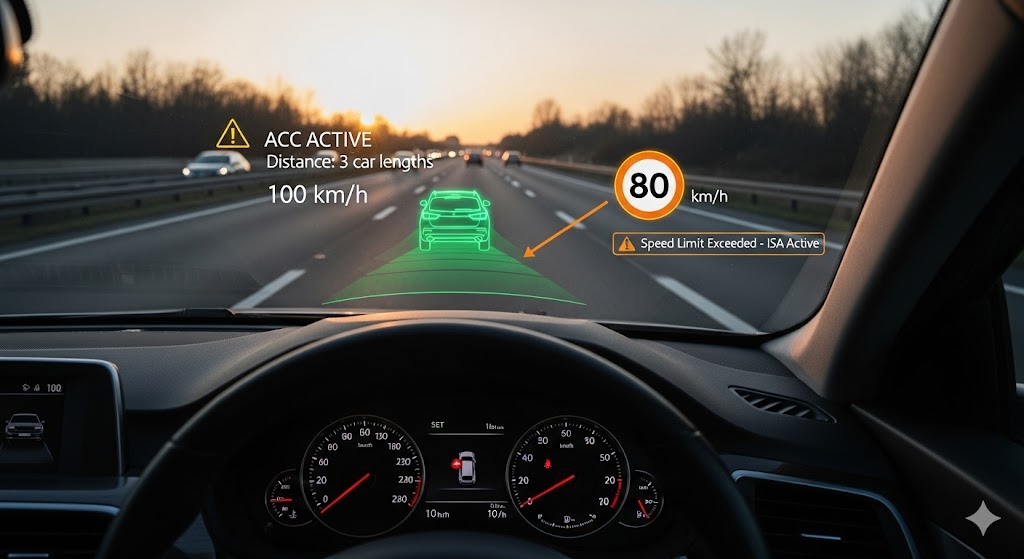
A new study led by researchers from NORD University and Politecnico di Torino introduces an innovative approach to improving road safety through advanced driver assistance systems (ADAS). The paper, titled “An Integrated Intelligent Speed Adaptation System for Enhanced Driver Assistance, Driving Performance and Safety”, has been accepted for publication in Transportation Engineering.
What’s the Problem?
Adaptive Cruise Control (ACC) is widely used to maintain speed and safe following distances. However, ACC struggles on curves with limited visibility, where drivers often misjudge safe speeds. This can lead to dangerous situations, especially when no lead vehicle is present.
The Proposed Solution
The research team developed and tested an integrated system combining:
- Adaptive Cruise Control (ACC) – for maintaining speed and headway.
- Intelligent Speed Adaptation for Visibility (V-ISA) – a novel algorithm that adjusts speed based on real-time sight distance.
This integration ensures that vehicle speed remains within safe limits on curves with restricted visibility, reducing crash risk without increasing driver workload.
Key Findings
- Improved Safety on Curves: The ACC + V-ISA system significantly reduced speed on sharp curves with limited sight distance.
- No Added Mental Load: NASA-TLX assessments showed no increase in driver workload compared to ACC alone.
- High User Acceptance: Drivers rated the integrated system as useful and satisfying, similar to standard ACC.
- Stable Vehicle Control: Lateral performance remained unaffected, meaning safer speed control without compromising steering.
Why It Matters
This research demonstrates that visibility-based speed adaptation can complement existing ADAS technologies, paving the way for safer roads and future autonomous driving systems. By aligning speed with stopping distance, the system helps drivers comply with traffic regulations that require maintaining control and stopping within the visible roadway.
Next Steps
The study was conducted in a high-fidelity driving simulator. Future work will focus on real-world implementation and integration with technologies like LiDAR for dynamic sight distance measurement.