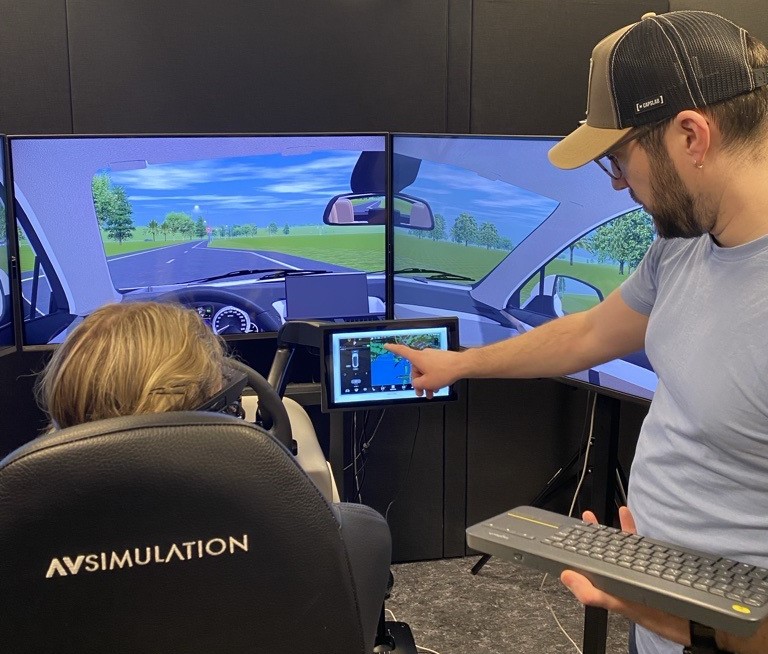
With advanced infotainment technologies becoming standard in modern vehicles, in-car touchscreens now play a central role in the driving experience. Despite their utility, these systems pose significant challenges, particularly in terms of driver distraction and unfamiliar controls. A recent investigation at the TRAFIKKLAB sought to determine whether short pre-drive training could enhance drivers’ touchscreen skills and reduce distractions during use.
The research engaged 60 licensed Norwegian participants, evenly divided into trained and untrained groups. Utilizing a fixed-base driving simulator (THOR) and Eye Tracking Glasses, drivers navigated simulated motorway while handling secondary tasks on the touchscreen, such as modifying the climate settings or switching radio channels (activities frequently performed in everyday driving). The trained group received concise, targeted instructions on operating the interface prior to driving, whereas the untrained participants were left to interact with the system without preparation.
Results
Task Proficiency Improves: The trained group demonstrated higher task completion rates compared to their untrained counterparts. However, the increase in task completion did not translate to statistically significant improvements in driving performance metrics such as speed consistency or lateral control.
Challenges with Distraction: Distraction caused by using the in-car touchscreens resulted in more variability in speed and less stable lane positioning in both groups, suggesting that the brief training was insufficient to offset the cognitive load of multitasking.
Learning Over Time: Drivers across both groups improved in lateral control with repeated task performance, showcasing the value of familiarity and experience. However, this progression was independent of the pre-drive training.
Implications and Future Directions:
While short pre-drive training improved familiarity with in-car touchscreens interfaces, the results indicate its limited impact on overall driving safety. This highlights the need for more immersive or interactive training methods and advanced interface designs that minimize driver distraction. Future studies should focus on the long-term effects of training and its scalability across different vehicles and driver demographics.
This research contributes to the growing dialogue on balancing innovation in vehicle design with road safety, emphasizing the need for continued development in driver education and technology optimization.
People

Giuseppe Marinelli
Associate Professor

Abrar Hazoor
Researcher

Mats Hay
Student

Mathea Lindseth Eriksen
Student

Kjell Kåre Hoem
Student

Simen Aannerud Gulbrandsen
Student

Chris Fredriksen
Student