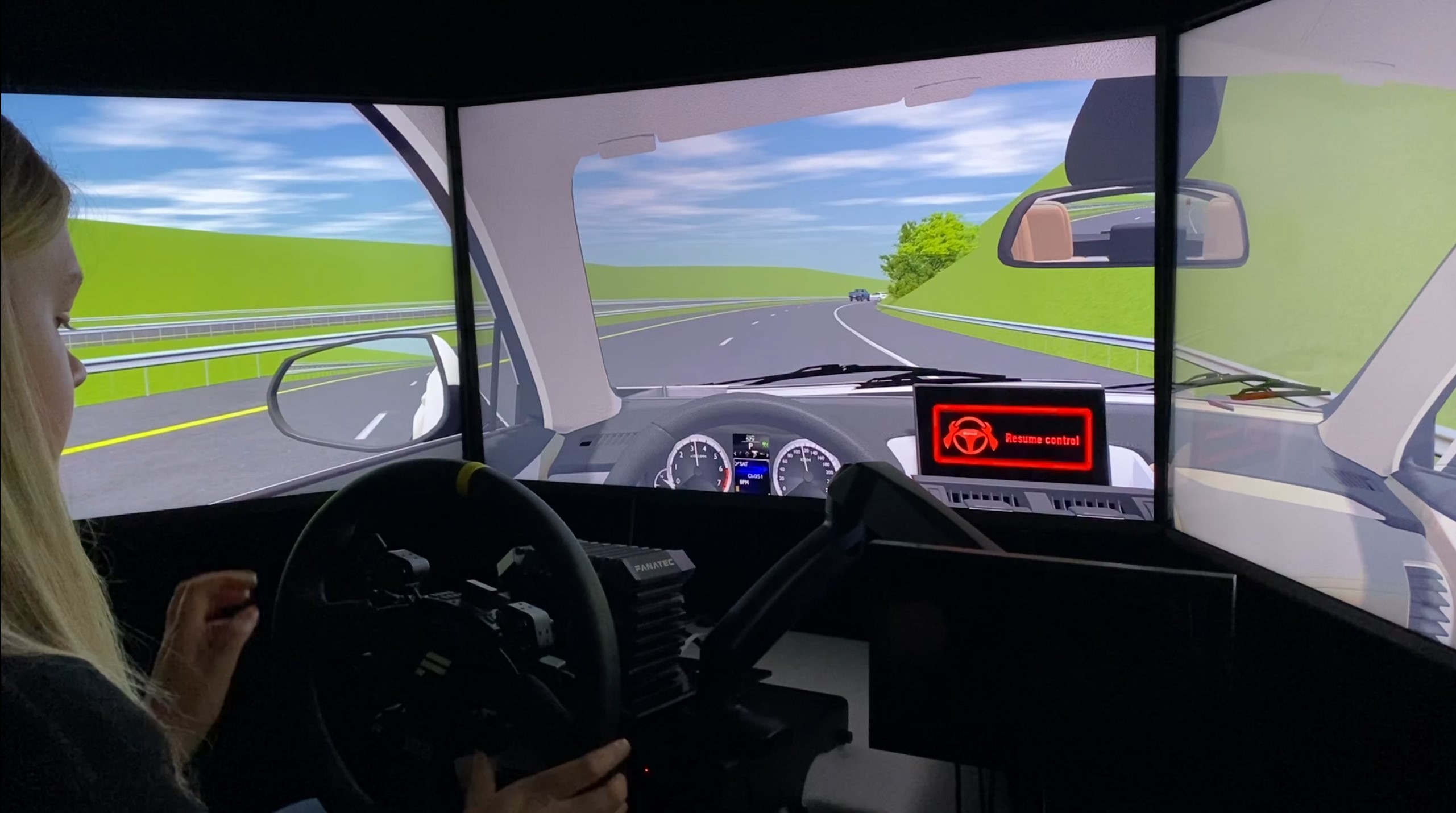
As the era of Conditionally Automated Driving (CAD) advances, striking a balance between automation and human intervention has become crucial for road safety. CAD systems, classified as Level 3 automation by the Society of Automotive Engineers (SAE), require drivers to take over control (TOC) during specific scenarios. Evaluating the efficiency of different TOC mechanisms is vital to improving safety and user trust in these systems.
In a collaborative study between NORD University (Norway) and Politecnico di Torino (Italy), experiments were conducted at TRAFIKKLAB using a fixed-base driving simulator (THOR). The study assessed three TOC mechanisms: (i) pedal actions (accelerate/brake), (ii) pressing a button, and (iii) steering, with thirty Norwegian drivers in merging, diverging, and critical collision-avoidance scenarios.
Key Findings:
Pedal Mechanism: Found to be the most effective, it resulted in the fastest reaction times, shortest TOC durations, and the highest Minimum Time-to-Collision (MTTC) values, particularly during emergencies.
Button Mechanism: While easy to operate, this method showed the slowest reaction times and the lowest MTTC values, indicating higher safety risks.
Steering Mechanism: Although natural for lateral control, this option required higher cognitive effort, leading to longer TOC durations and increased acceleration variability.
Research Insights & Future directions: The study highlights the dominance of intuitive mechanisms like pedal-based control, which leverage drivers’ familiarity to enhance response speed and safety. The findings support the further development of multi-modal TOC systems that integrate the strengths of various mechanisms. Additionally, future research should incorporate various traffic conditions and potential driver distractions to expand understanding of TOC effectiveness.
Results
-
Comparative Safety Analysis of Take-over Control Mechanisms of Conditionally Automated Vehicles
-
Influence of Traffic Flow and Merging/Diverging Ramp Design on Take-Over performance: A Cross-Country Comparison of Conditionally Automated Vehicles
-
Impact of Take-Over Control Mechanisms on Merging Operations of Conditionally Automated Vehicles
-
Comparative Safety Analysis of Take-over Control Mechanisms of Conditionally Automated Vehicles