Title of the artwork: Jewels from the sea
Research theme: How do snails adapt to different temperatures? (Anja Westram, read more…)
From the artist: In the photographic project ‘Jewels from the Sea,’ Julie Hrnčířová builds on her previous work, mainly on the projects “Everyday Sculptures” and “Urban Poetism”, where she focuses on photographing various found objects and thrown-out elements in the city and urban spaces left by people. What interests her is what people leave behind them as traces and all kinds of banal seemingly invisible things that surround us.
In this series, the artist collects small pieces of glass, shards, and plastics found in the sea and smoothed by seawater. With these elements, she created assemblages combined with seaweed, shells, and stones, creating compositions which she then photographed from an unexpected closeness that transformed the given elements to show them in a new perspective.
The final photographs should evoke unsettling but at the same time calming and reconciling feelings and emotions about how we treat our environment, but it is also a reflection of our society of consumption, and how we treat nature and the ocean. Natural and man-made objects are mixed in the compositions and they camouflage each other. The boundary between what is natural and artificially created is lost. In this project, I am questioning how humans influence the ocean and how the objects left by people in the sea communicate with the natural flora and fauna.
More about the artist: web site / Instagramm
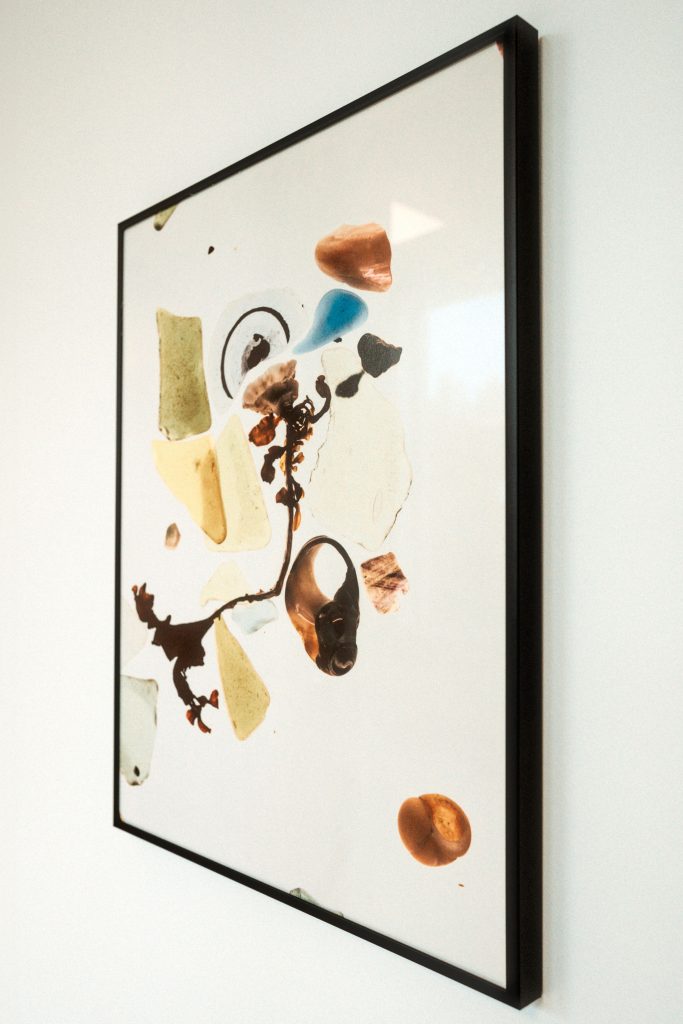
The results evoke abstract paintings and surrealistic sculptures, in which the viewer gets pleasantly lost and provides space for thinking and dreaming.
Like the art project, the scientific project „The genomic basis of temperature adaptation across space“ explores the interactions between sea creatures, the forces of the natural environment, and human influence. The project asks how sea snails of the genus Littorina – visible in some of the art pieces – are shaped by their environment, both at the level of shell characteristics (such as shape and size) and at the genetic level.
The human-made pieces of glass and plastic are modified by the forces of the sea over their lifetime. The same forces modify the appearance, physiology and genetic characteristics of the snails over evolutionary time. For example, snails exposed to more wave forces have evolved to be smaller, allowing them to hide in crevices. They have also evolved large genomic mutations that distinguish them from snails living in calmer environments.
Both the scientific project and the photography project zoom into details that are often missed in everyday experience. The scientific work uses DNA sequencing to find genes that help snails adapt to different temperatures – for example, to understand how they can withstand extreme heat or cold, such as being frozen in the ice (as shown in the photo). This will help understanding how sea creatures will respond to human-caused climate extremes. Thus, both the artwork and the scientific project allow a glimpse into how our seas are changing under human influence.