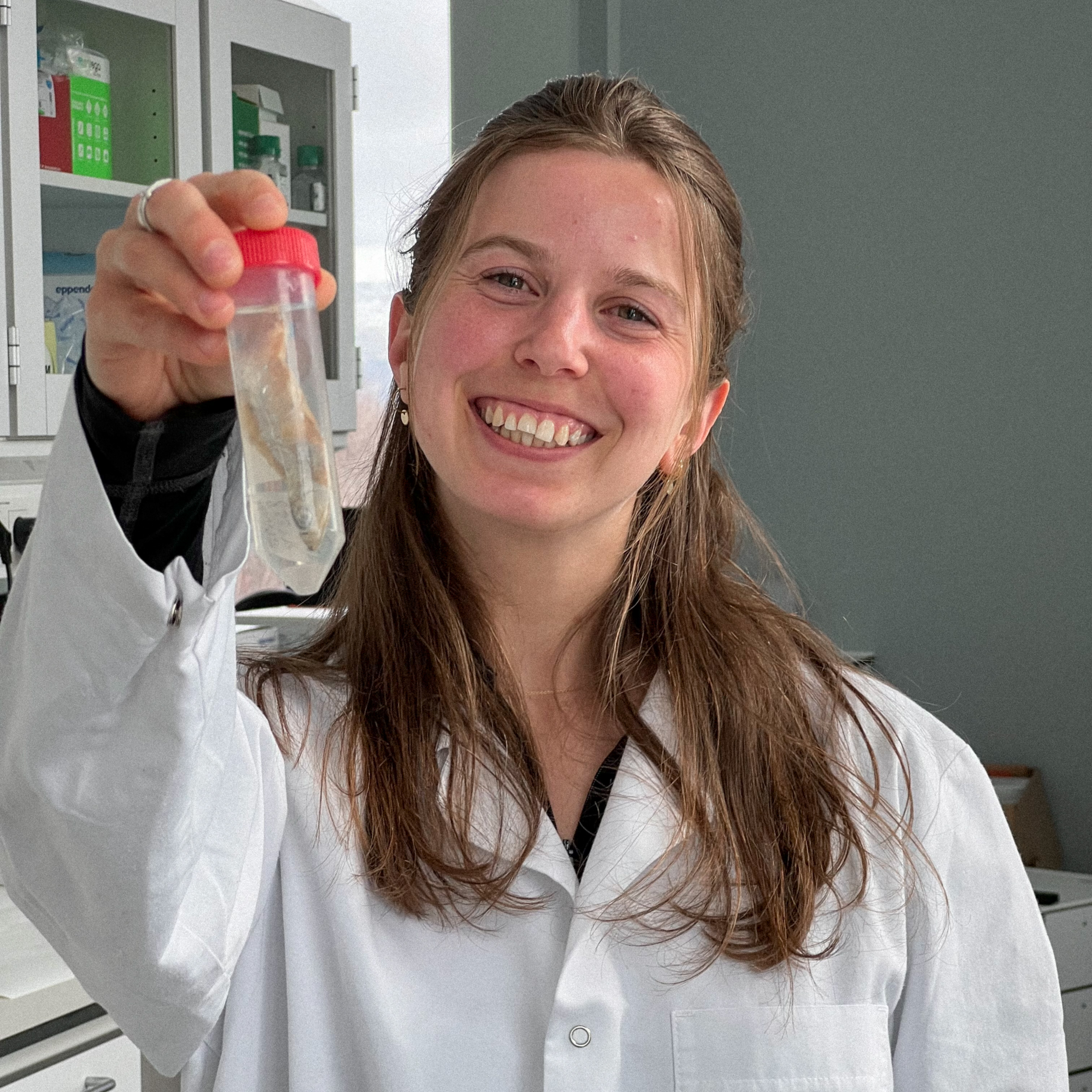
I am an ecologist with a strong interest in the aquatic environment. Over the course of my education and experiences, I have explored various subjects related to it. I hold a master’s in Ecology and Biology of Organisms from the Catholic University of Louvain (UCLouvain) and University of Namur (Belgium), where my master’s thesis explored the morphophysiological adaptation of sharks’ respiratory systems to the deep-sea ecosystem. During this time, I also studied the application of eDNA to delimit chondrichthyans’ distribution and the impacts of aquaculture farms on community composition using BRUVs, as an intern at the Institute of Marine Research (Norway). Within a second master’s in Marine and Lacustrine Science and Management at the Free University of Brussels (VUB), Ghent University, and Antwerp University, I investigated the data-limited stock assessment of rays. During this time, I also explored the impacts of electromagnetic fields on the development of benthic organisms within a volunteer position at the Institute of Natural Sciences (Belgium). Within an additional internship at the Institute of Marine Research (Norway), I investigated the population genomics of chimaeras.
These experiences have fostered my curiosity in understanding ecological processes and the impacts of human activities at various levels. My main interests lie in the study of how individual biology translates into population ecology and community ecology, and then evolutionary patterns. My lifelong goal is to contribute to more informed, science-based management and the conservation of ecosystems within a social-ecological system framework. If along the way I can meet cool creatures, animal or human, then we’ll call it a success.
With this goal in mind, my PhD thesis at Nord University within the CHIPOLATA project will investigate the effects of climate change and fisheries on the pelagic fish community of Lake Tanganyika. More precisely, I will focus on the impacts on the population structure, adaptive selection, and growth and maturity patterns. To achieve this, I plan to use genomic tools, length-frequency analysis, and otholiths analysis. The overall objective of my thesis is to explore factors that influence their long-term resilience and to translate these results into indicators that can be used for management measures aimed at promoting sustainable biodiversity conservation and fishing activities.
Outside of academia, I will never say no to a hike/ski/rock-climbing session, to go out looking for small and big creatures, or to some good chocolate.
Contact Ilona