
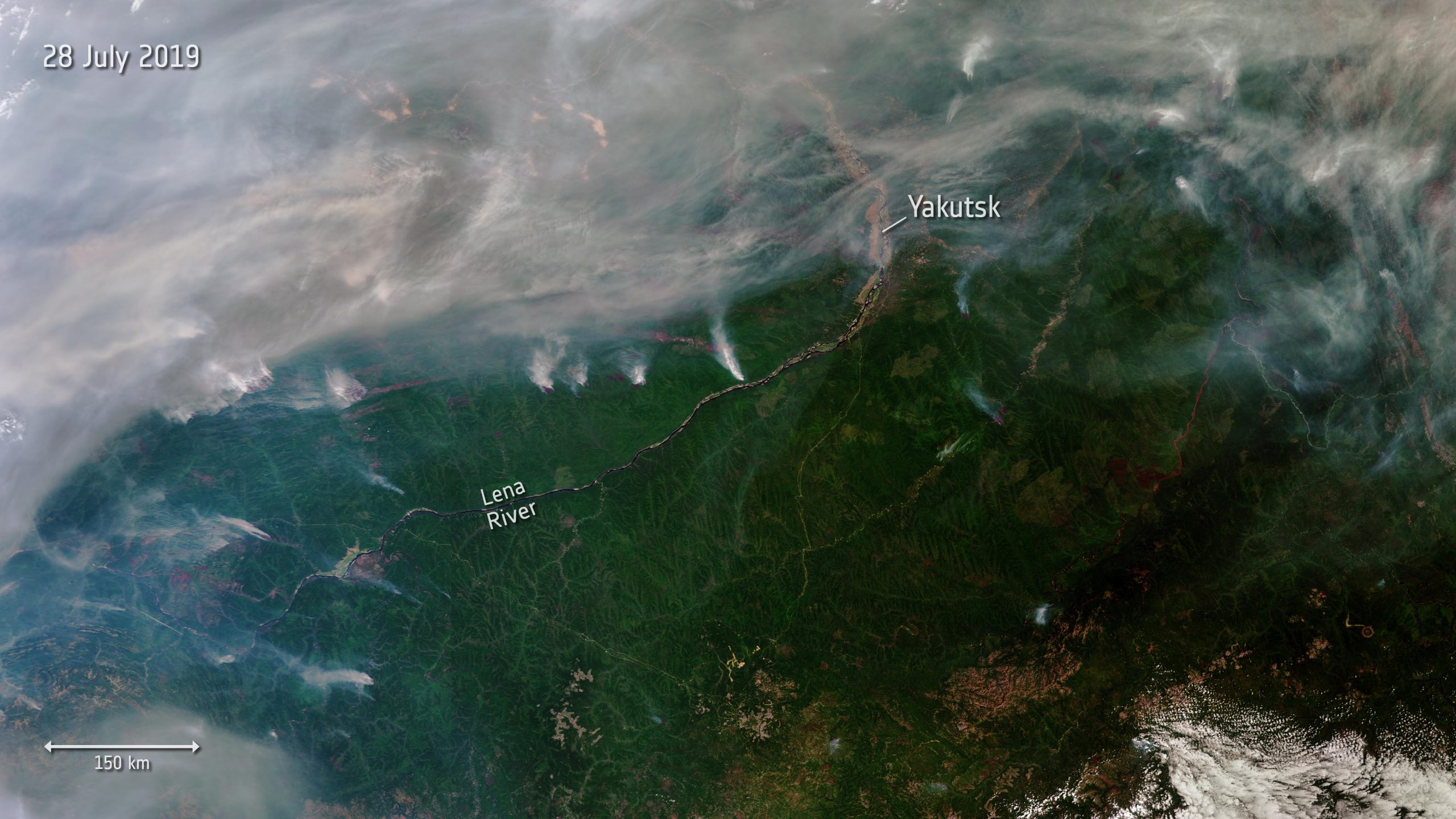
As boreal wildfires burned through a record-breaking 2025 season across Canada, Siberia and Alaska, the question for 2026 is whether conditions will ease — or intensify.
Early forecasts point to a later start in parts of northern Canada, but drought in key fire zones and the possible emergence of a strong El Niño later in the year are keeping scientists watchful. Against this backdrop, we revisit ArcSolution research from 2024 that explains what these escalating fire seasons mean for a pollution risk most people have never heard of — and why the Arctic is paying the price.
The ArcSolution study “Dioxins in the Arctic: local sources vs. long-range transport” shows that burning landscapes — not just industrial pollution — are driving dioxin contamination in the Arctic atmosphere, with implications for the region’s fragile ecosystems.
What the study investigated
Dioxins — a group of highly toxic persistent organic pollutants formally known as polychlorinated dibenzo-p-dioxins and dibenzofurans (PCDD/Fs) — have long been a concern in the Arctic. They are known to accumulate in ecosystems, move through food webs, and pose risks to both wildlife and human health. But where are Arctic dioxins actually coming from?
A 2024 study published in Environmental Science: Advances set out to answer this question. Using an updated global dioxin emission inventory covering 2011 to 2020, combined with an atmospheric transport model, the researchers tracked how dioxins move through the atmosphere and accumulate in the Arctic.
A striking finding: wildfires now dominate
The results challenge the conventional picture of Arctic contamination as primarily an industrial problem carried north from distant sources.
The study found that wildfire emissions have become the dominant contributor to dioxin concentrations in Arctic air — accounting for around 70% of PCDD/F levels in 2020. Within the Arctic Circle itself, wildfire emissions surpassed anthropogenic — meaning human industrial — sources in the late 2010s, a threshold that appears to reflect a genuine shift driven by climate change.
This matters because wildfire frequency and intensity in northern territories have increased significantly over the past decade. As the climate warms, forests and peatlands across the northern hemisphere are burning more often and more severely, releasing dioxins that then travel atmospherically into the Arctic.
Long-range transport still plays a role
The study does not dismiss the importance of distant industrial sources. Long-range atmospheric transport — the process by which pollutants produced far from the Arctic drift northward on air currents — remains a meaningful pathway. But the research suggests that the balance is shifting, and that local and near-local wildfire emissions are increasingly driving what Arctic communities and ecosystems are exposed to.
Why this matters
Dioxins are not simply an atmospheric concern. They deposit into Arctic ecosystems, accumulate in sediments and water, and move up through food webs — from small marine organisms to fish, seabirds, and marine mammals. For communities that depend on these species as food sources, dioxin levels in the environment translate directly into questions of dietary exposure and long-term health.
The findings also complicate the policy picture. Efforts to reduce dioxin pollution in the Arctic through industrial emission controls — which have had real success over recent decades — may be increasingly offset by wildfire emissions that are harder to regulate directly and are themselves a consequence of climate change.
About the research
This study is part of ArcSolution, the EU Horizon Europe-funded project examining Arctic pollution through a One Health lens. It was led by Prof. Tao Huang and colleagues at Lanzhou University’s Key Laboratory for Environmental Pollution Simulation and Control, in collaboration with researchers at Peking University — bringing atmospheric modelling expertise from China to bear on one of the Arctic’s most pressing contamination questions.
Your can read full report here: Dioxins in the Arctic: local sources vs. long-range transport – Environmental Science: Advances (RSC Publishing)