
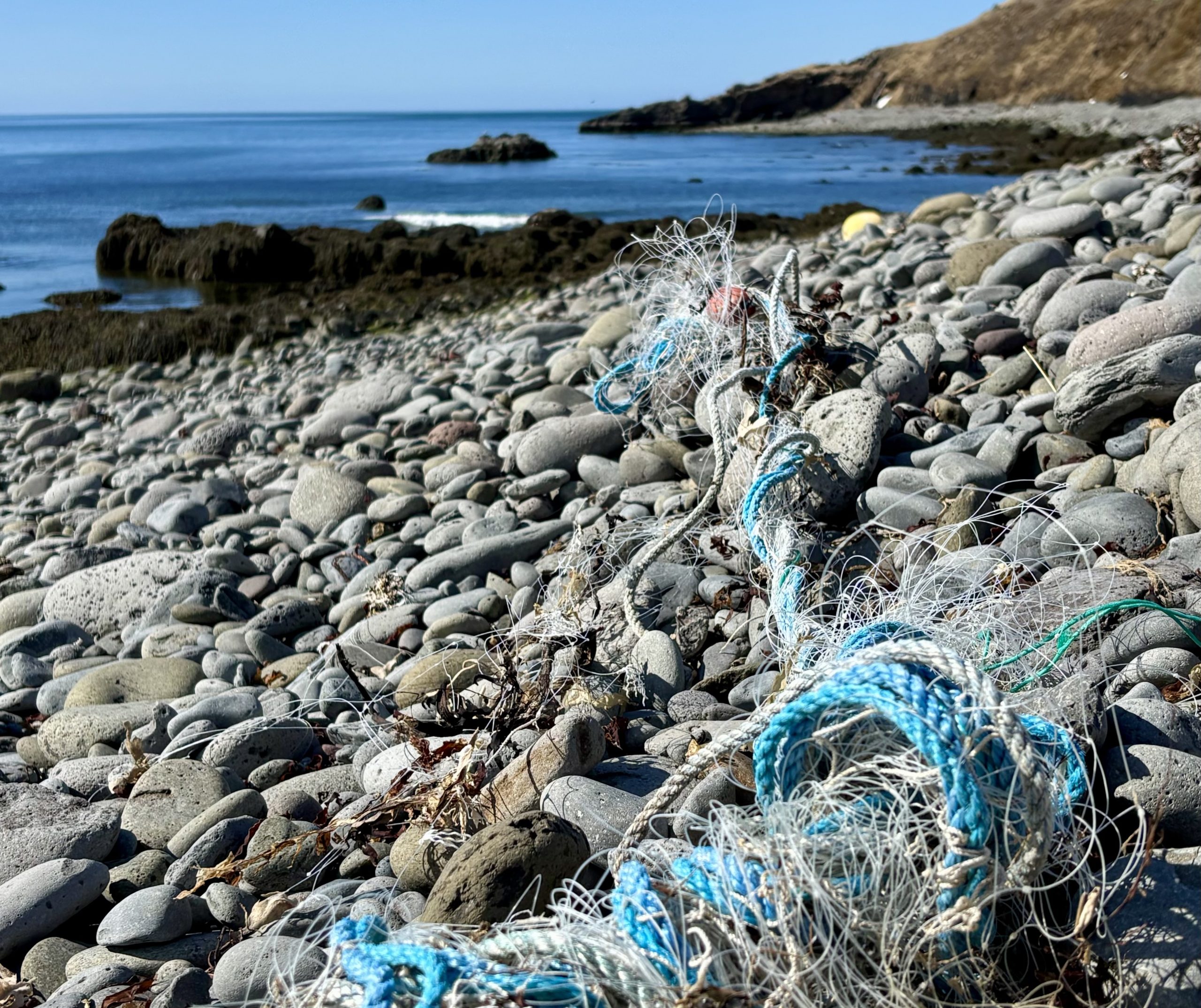
Marine plastic pollution is a growing challenge in the Arctic, affecting ecosystems, wildlife, fisheries and coastal communities.
In ArcSolution webinar #6, Julia Olsen and Christian Carl explored different aspects of the problem, from preventing marine litter in the European Arctic to the development and testing of biodegradable materials for fisheries and aquaculture.
The session was chaired by Lars-Otto Reiersen, former executive director of the Arctic Monitoring and Assessment Programme (AMAP).
Preventing marine litter in the European Arctic: practices, institutions and infrastructures
Julia Olsen, Associate Professor in Environmental Sociology at Nord University, opened the webinar by discussing how marine litter can be prevented, with particular attention to institutions, infrastructure and practices.
She began with the story of a whale that stranded on the Norwegian coast in 2017. An examination found around 30 plastic bags in its stomach, blocking its digestive system. Although plastic pollution in the marine environment had already been documented for decades, the incident attracted widespread attention and highlighted the growing problem of marine litter.
Marine litter is found throughout Arctic ecosystems, from the seabed and coastal areas to the water column and sea ice, as well as in wildlife. Its impacts are both environmental and socio-economic. Wildlife can be affected through ingestion of plastic and entanglement in lost fishing gear, often resulting in injury or death. Drifting debris can also transport invasive species, while marine litter threatens food security through contamination of fish and seafood. Debris in the sea and along coastlines can create risks for vessels, including damage to propellers, and contributes to the erosion of the Arctic’s image as a pristine and remote region.
Sources of marine litter
Olsen emphasized that marine litter in the Arctic comes from both local and remote sources. The region is connected to global systems of production and consumption, while activities within the Arctic also contribute directly to the problem.
Local land-based sources include waste from coastal settlements and tourism, as well as waste transported by rivers. Fisheries and aquaculture are important sea-based sources, particularly through discarded fishing gear. Historical waste-management practices have also contributed to pollution, while ineffective waste and wastewater systems can allow plastic and microplastic to enter the marine environment.
Ocean currents transport debris over long distances, carrying litter from lower latitudes into Arctic waters. Shipping activities are another source. Together, these factors help explain why marine litter can be found even in remote Arctic communities.
Abandoned, lost and otherwise discarded fishing gear is a particularly important source of plastic debris in the European Arctic. Studies show that approximately 30–40% of beach litter items are related to fisheries, including nets, ropes, lines and traps. While fishing-related items may represent fewer individual pieces than other types of waste, they account for a large share of the litter by weight because fishing gear is generally heavier.
In Norway alone, fishers contribute around 800 tonnes of marine litter annually, according to the figures presented by Olsen. This includes approximately 400 tonnes of ropes and a similar amount of fishing gear such as crab pots, longlines, nets and traps. Fishers also regularly collect waste from other sources when it becomes entangled in their gear, creating additional costs and requiring time and effort to transport the waste back to harbour.
Lost fishing gear can also cause ghost fishing, where equipment continues to catch marine life after it has been lost. Passive gear such as gillnets, fish traps and pots has a particularly high risk of being lost and causing ghost fishing, while lost nets and trawls can also cause other fishing gear to become entangled and lost.
Institutions, infrastructure and practices
Olsen presented three interconnected areas where preventive measures can be developed: institutions, infrastructure and practices.
At the international level, several treaties and conventions address marine pollution. The International Maritime Organization addresses ship-generated marine litter, including through MARPOL, while the Polar Code establishes rules for ships operating in Arctic waters. The UN Convention on the Law of the Sea provides a broader framework for protecting and preserving the marine environment.
At the European Union level, Olsen highlighted extended producer responsibility for fishing gear. This approach incorporates waste-management costs into the price of products, following the polluter-pays principle.
The Arctic Council is another important forum for addressing marine litter in the Arctic. Although it does not create binding laws, it coordinates policy, science and action among the eight Arctic states and Indigenous Permanent Participants. Its working groups, including PAME, AMAP and CAFF, address impacts of marine litter and preventive measures. The Arctic Council also cooperates closely with OSPAR Commission.
National and local authorities, municipalities and research institutions also play important roles through waste-management policies, research, monitoring and evaluation of preventive measures.
However, institutions and regulations need to be supported by adequate infrastructure. Improving waste and wastewater management in Arctic communities and ports is essential to prevent litter from entering the marine environment. This includes reception and sorting facilities that allow fishing vessels and other marine operators to dispose of waste and lost gear safely.
Olsen also highlighted the importance of facilities supporting repair, reuse and recycling. She pointed to Nofir as an example of a company collecting and recycling discarded fishing gear along the Norwegian coast. However, recycling fishing gear can be challenging because equipment may be contaminated with biomass, fish oil and sand, and because some gear consists of several different materials that are difficult to separate.
Changing practices and generating knowledge
A range of practices have been developed to prevent and reduce marine litter, particularly in fisheries and aquaculture. Olsen highlighted the importance of behavioural change and circular economy approaches, including reducing, reusing and recycling materials. Education and increased awareness are also important.
The Norwegian Directorate of Fisheries conducts annual retrieval surveys of fishing gear in Norwegian waters. The Fishing for Litter programme also encourages fishers to collect waste encountered during fishing operations.
Technological and material innovation provides another potential pathway. Olsen highlighted the development of biodegradable materials for fishing and aquaculture, which was explored further in the second presentation.
Beach cleanups are another widespread activity across the Arctic. Between 2021 and 2024, 149 cleanup initiatives registered through the Arctic cleanup initiatives collected 132 tonnes of waste, representing nearly 160,000 individual items. These activities do more than remove litter. They can help identify sources, raise awareness in local communities and provide valuable data on the distribution of marine litter.
Cruise operators under the Association of Arctic Expedition Cruise Operators have also participated in cleanup initiatives in the Arctic, including on Svalbard and, since 2023, in Iceland.
Citizen science can contribute to monitoring as well. Olsen highlighted ArcSolution’s Plastic and Marine Life in the Arctic initiative on the iNaturalist platform, which aims to collect data on the impacts of marine litter on Arctic wildlife. Preliminary results from this initiative were presented during the first ArcSolution webinar.
Remaining knowledge gaps
Despite the growing body of research, Olsen emphasized that important knowledge gaps remain. More research is needed to understand the sources, pathways and drivers of marine litter in a rapidly changing Arctic.
Ocean currents transport floating plastic northwards, while changes such as melting sea ice and shifts in fish stocks may affect the distribution of marine litter and the movement of fishing vessels. There is also a need to harmonize monitoring methods and data collection to better quantify litter originating from fisheries and identify changes over time.
Olsen concluded by emphasizing that awareness alone is not enough. Even when communities and industries are aware of the problem and want to manage waste responsibly, they need sufficient infrastructure to collect, handle and recycle it.
Reducing marine litter from fisheries, aquaculture and shipping, improving onshore waste and wastewater management, promoting sustainable material management and eco-design, cleaning Arctic coastlines and strengthening cooperation are therefore all important parts of the response.
Making lost fishing nets disappear: research on biodegradable polymers
The second presentation was given by Christian Carl from SINTEF Industry. He presented research from the Dsolve project, which focuses on biodegradable materials for fisheries and aquaculture.
Fishing and aquaculture use a wide range of plastic products, including handlines, pots, longlines, gillnets and trawls. These materials have limited service lives, raising questions about what happens after they reach the end of their useful life. Reuse, recycling, incineration and landfill are among the possible pathways.
At the same time, fishing gear can contribute to marine pollution while it is in use. Abrasion and wear can result in the release of macro- and microplastics. When gear is lost, it can also contribute to ghost fishing, creating environmental problems as well as losses of income and resources for fisheries.
Carl presented examples of used ropes and fishing gear showing the effects of abrasion and wear. The examples illustrated the challenge of developing materials that can perform during their intended service life while reducing their environmental impact when they are lost.
The Dsolve project
The Dsolve centre was established in 2020 with the aim of reducing plastic litter and associated problems such as ghost fishing and microplastics caused by the fisheries and aquaculture industries.
A central goal is to replace traditional plastics in these sectors with new biodegradable materials wherever possible.
The project brings together research and development across several areas, including the development and fabrication of biodegradable polymers, assessment of biodegradability, development and testing of fishing gear at sea, governance and incentives, circularity and life-cycle analysis. Industry and end users are also involved, with industrial-scale development among the project’s ambitions.
Testing biodegradable materials
A central part of the research is understanding how biodegradable materials behave in different environments.
Dsolve uses laboratory and field trials to investigate weathering and biodegradation, comparing biodegradable and conventional materials under different conditions. The researchers use methods including accelerated ageing, abrasion and friction tests, as well as longer-term field trials.
The research presented by Carl showed that laboratory and field conditions can produce different results. Materials kept submerged in practice may behave differently from materials that are removed from the water and dried for periods of time in laboratory tests.
The researchers have also observed substantial differences in predicted degradation times between different biodegradable materials. Their work examines how factors such as pre-ageing, UV exposure, temperature, light and location influence degradation.
Long-term field trials in several countries are being used to investigate degradation under different environmental conditions. Further laboratory and field experiments are ongoing, including work with UV-exposed and non-UV-exposed materials.
Finding the right balance
Carl emphasized that biodegradable materials raise a number of important questions. The materials need to be suitable for their intended use during their service life, while also being able to degrade under appropriate conditions afterwards.
At the same time, reuse, recycling and disposal need to be considered as part of the development of new materials.
Among the questions highlighted in the presentation were how biodegradable polymers should be designed and tested, how and where biodegradable plastics should be disposed of, and how new materials can be developed into practical products for fisheries and aquaculture.
Further field and fishing trials will help researchers gain a better understanding of how the materials perform under realistic conditions.
To sum it all up
The two presentations approached Arctic marine plastic pollution from complementary angles.
Julia Olsen highlighted the importance of preventing marine litter at its source. This requires action across institutions, infrastructure and everyday practices, with particular attention to fisheries, aquaculture and other marine activities. Better waste-management infrastructure, monitoring, cleanups, citizen science and cooperation between stakeholders can all contribute to reducing the amount of litter entering the Arctic marine environment.
Christian Carl showed how material research could contribute to the same goal. Developing biodegradable fishing gear may help reduce some of the problems associated with lost gear, ghost fishing and plastic degradation. At the same time, the research demonstrates that biodegradable materials are not a simple replacement for conventional plastics. Their performance, degradation under different environmental conditions, and options for reuse, recycling and disposal all need to be understood.
Together, the presentations underline that there is no single solution to marine plastic pollution in the Arctic. Tackling the problem requires coordinated efforts across institutions, infrastructure, practices and material development.