
For a long time, people have regarded the ocean as almost infinite. What was thrown into the sea seemingly disappeared. In recent years, however, there has been growing awareness that both old and new mistakes are resurfacing — quite literally.
Plastic waste that ends up in the ocean is found on beaches, in the stomachs of fish and seabirds, and even in our own bodies.
Bringing Stakeholders Together
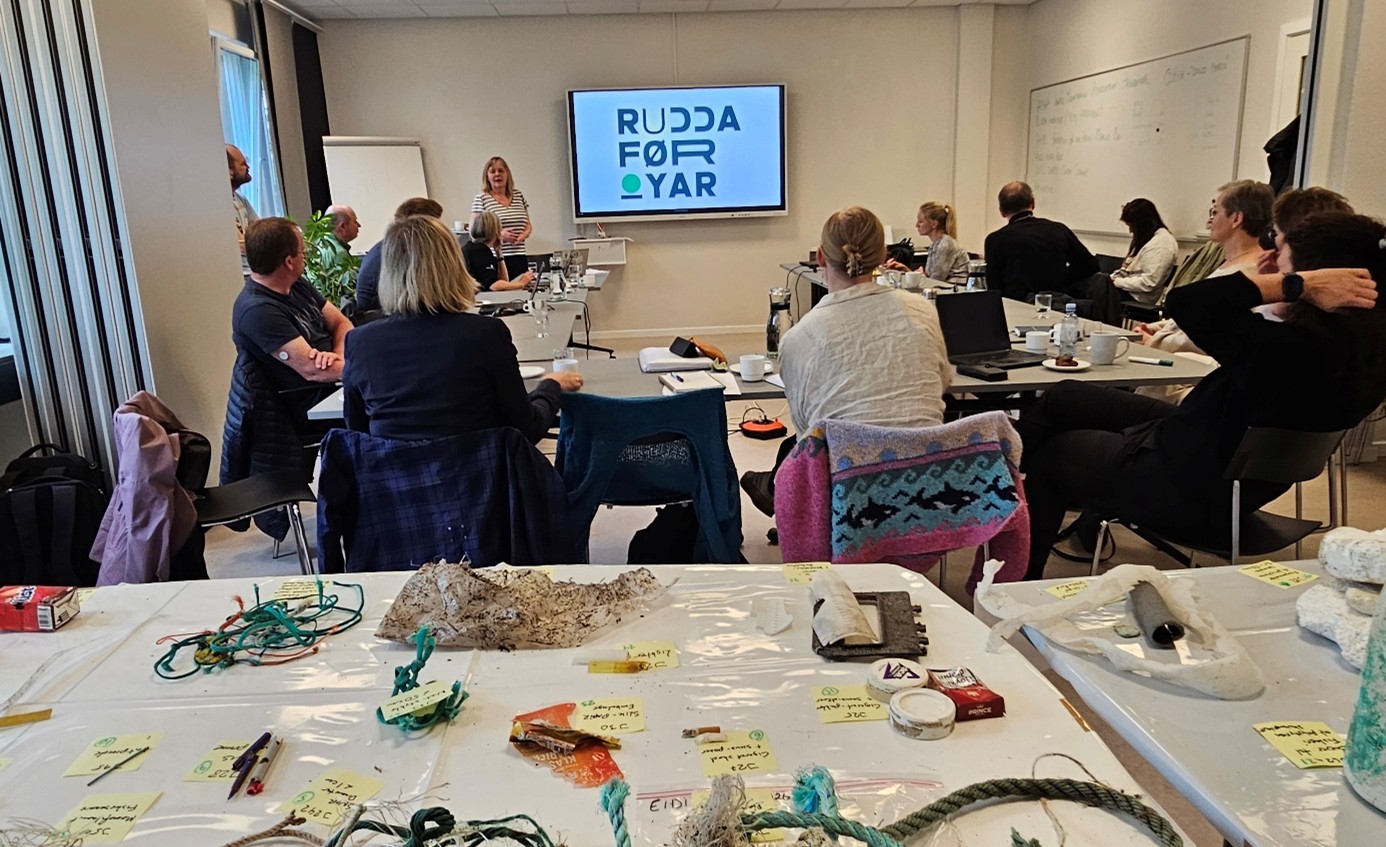
ArcSolution/Aarhus University (AU), together with Umhvørvisstovan, the Faroese Environment Agency, held a workshop on plastic litter in Tórshavn titled “Marine Plastic Pollution on Faroese Beaches – From Beach Findings to Solutions”. The event brought together a diverse group of participants representing a wide range of stakeholders. These included local environmental authorities, beach litter monitoring surveyors, volunteers engaged in clean-up efforts, and professionals from the fisheries and aquaculture sectors. In addition, researchers from three Nordic countries contributed scientific expertise and regional perspectives. This combination of practical experience and research-based knowledge supported a comprehensive and informed discussion of marine litter challenges in the Faroe Islands.
Research and Knowledge Sharing
The workshop began with a presentation by Jakob Strand from Aarhus University, who outlined methods for monitoring amounts and composition on shorelines as also recommended within the international monitoring and assessment frameworks for the Arctic (AMAP) and the North Eastrt Atlantic (OSPAR). He noted that classification can be complex, but still in practice doable, when many different types of litter categories need to be identified according to the monitoring protocols. He also showed that systematic monitoring has documented a decline in beach litter over time, although levels remain too high.
Participants then heard updates from the Arctic Council working group PAME, on Arctic marine litter efforts and the “Plastic in a Bottle” project. The local organization Rudda Føroyar presented its clean-up work and international cooperation, while Umhvørvisstovan shared experiences form their shoreline litter monitoring initiated in 2025 and from other local studies showing how plastic can move through the food chain, for example when great skuas feed on seabirds such as northern fulmars.
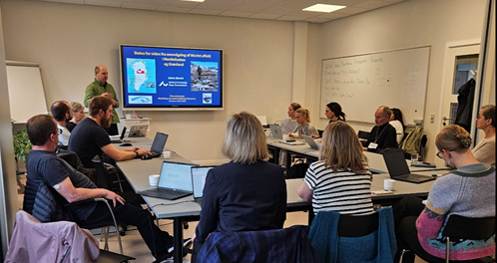
Jakob Strand presenting status of the current research on marine litter.
Hands-on Source Identification
After the presentations, the practical part of the workshop began. Plastic waste collected from Faroese beaches was categorized, and possible sources were assessed. Each participant received a form to evaluate individual items: Could the waste have travelled from far away, or did it come from a local source? Was it thrown directly into the sea, or had it blown there from land? Which industry or activity could the waste be traced back to?
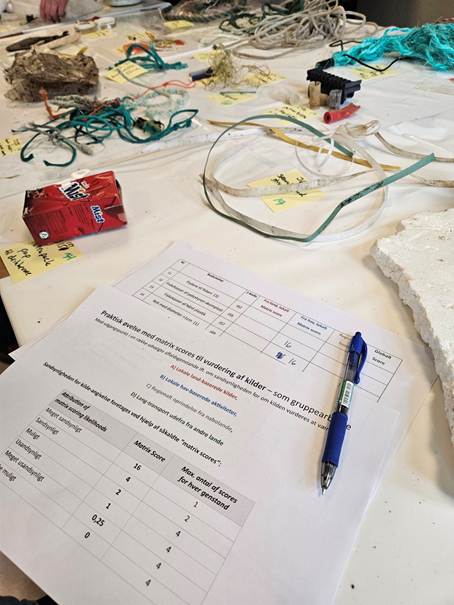
Matrix Scoring form used to assess the likelihood of sources of litter items collected from Faroese beaches.
Some items, such as cigarette packs, were relatively easy to categorize due to clear labelling. Other plastic waste, such as packaging, rope fragments and pieces of fishing gear, was more difficult to trace back to a specific source.
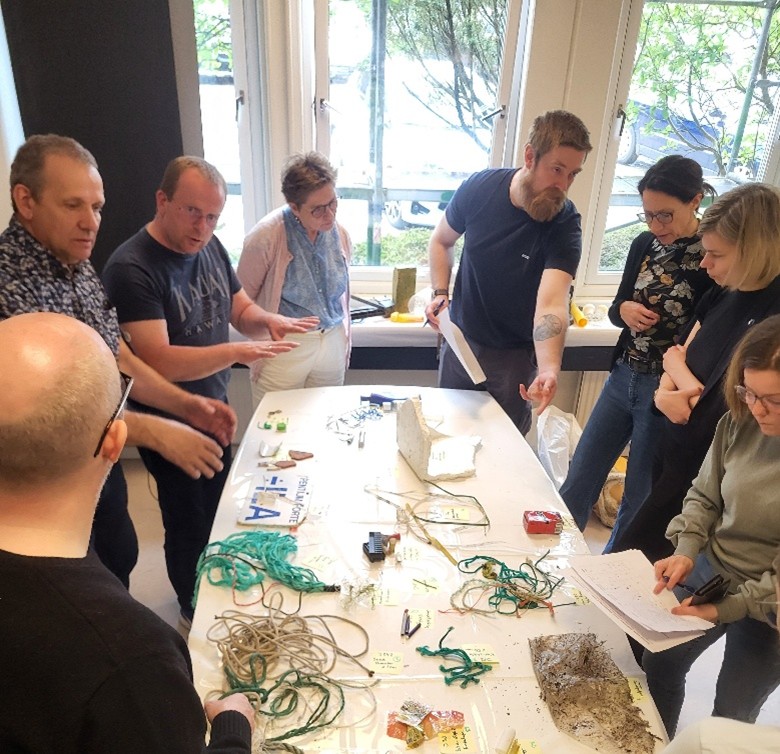
Thorough discussions between the different actors attending on the many marine litter categories at the workshop.
The results showed clear source patterns. Local land-based sources dominated overall (46%), especially for single-use plastics (72%) and other identifiable items (58%), highlighting the role of land-based consumption and waste management. Local sea-based activities contributed 27%, mainly to fishery-related items (44%), while regional sources accounted for 18%, particularly fishery-related waste (29%), indicating cross-border transport. Long-distance ocean-current transport was smaller (9%), making it less significant than local and regional inputs.
Overall, the workshop findings demonstrate that marine litter on Faroese beaches is primarily driven by local activities, both on land and at sea. Regional contributions also play a role, while long-distance transport appears to be relatively limited. These insights emphasize the importance of targeted local measures, including improved waste management, responsible fisheries practices, and continued monitoring and clean-up efforts, while also recognizing the need for regional cooperation to address transboundary marine litter.
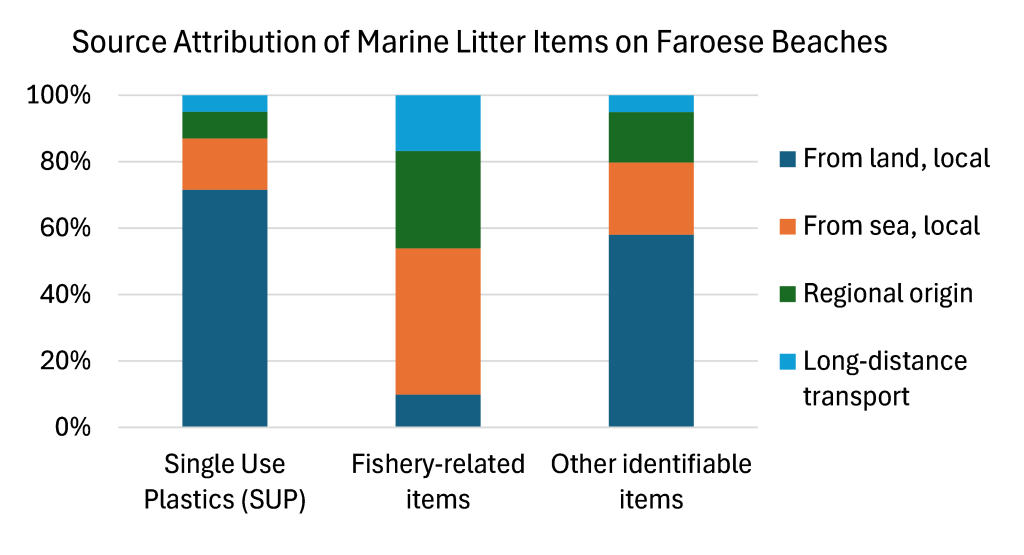
Results from workshop assessments applying the Matrix Scoring Technique to evaluate the likelihood of origin for 40 beach litter categories collected during monitoring surveys in the Faroe Islands over the past year.
From Mapping to Solutions
Such assessments are important when researchers map marine litter. By identifying the largest sources of pollution, it becomes possible to develop targeted solutions in cooperation with the relevant industries. Representatives from local aquaculture and fisheries companies took part in the workshop, and much of the waste could be linked to these two sectors. This highlights the importance of involving local industry in developing practical, locally adapted solutions.
Fisheries, Rope Fragments and Waste Handling
One typical source of plastic pollution is cut-off rope fragments from the repair of fishing gear. These are cut from nets or seines and may in some cases end up directly in the sea. A key question is therefore whether practices in the fishing industry can be changed so that small plastic fragments of this kind are handled more responsibly.
Representatives from the fisheries sector also pointed out that they often retrieve entire nets, seines and other larger waste items in their trawls, and argued that this should receive more attention than rope fragments alone. At the same time, it was emphasized that small rope fragments may be more accessible to seabirds, either because they are eaten directly or used as nesting material, whereas larger nets are less biologically available.
The fisheries representatives also stressed the importance of good waste management infrastructure at the quays. It must be easy and affordable to dispose of waste, particularly because fishers often bring ashore litter that does not originate from their own activities but is caught in their trawls.
Cooperation as the Way Forward
The workshop clearly demonstrated that efforts to combat plastic pollution require knowledge, systematic mapping and cooperation between research, authorities, voluntary organizations and industry. Effective solutions must be developed in close dialogue with those who know the local conditions best. Local action is particularly important, but regional cooperation is also needed to address litter that moves across borders and affects shared marine environments.