
ArcSolution continues to publish written summaries of its webinar series, making the discussions more accessible for readers who prefer text or would like to revisit previous webinars.
Moderated by Lars-Otto Reiersen, Webinar #3 explores how pollution in the Arctic is changing as a result of climate change and increasing human activity. The webinar features presentations by Katrin Vorkamp, who examines how climate change influences the behaviour of persistent pollutants, and Roland Kallenborn, who focuses on the growing importance of local emission sources across the Arctic.
Segment 1
A complex pollution situation affected by climate change
Many of the pollutants found in the Arctic originate far beyond the region itself. Katrin Vorkamp explains how persistent organic pollutants (POPs) released in industrial and agricultural regions are transported north by atmospheric circulation, rivers and ocean currents before becoming trapped in the Arctic’s cold environment.
Once they arrive, these chemicals accumulate in Arctic food webs. Because many POPs are fat-soluble, their concentrations increase at each trophic level through biomagnification, leaving top predators such as seals, whales and polar bears with the highest concentrations. This also affects human exposure, particularly for Indigenous communities whose traditional diets include marine mammals.
International regulation has successfully reduced emissions of many legacy pollutants through the Stockholm Convention. Long-term monitoring shows encouraging declines for several substances, demonstrating that coordinated global action can be effective.
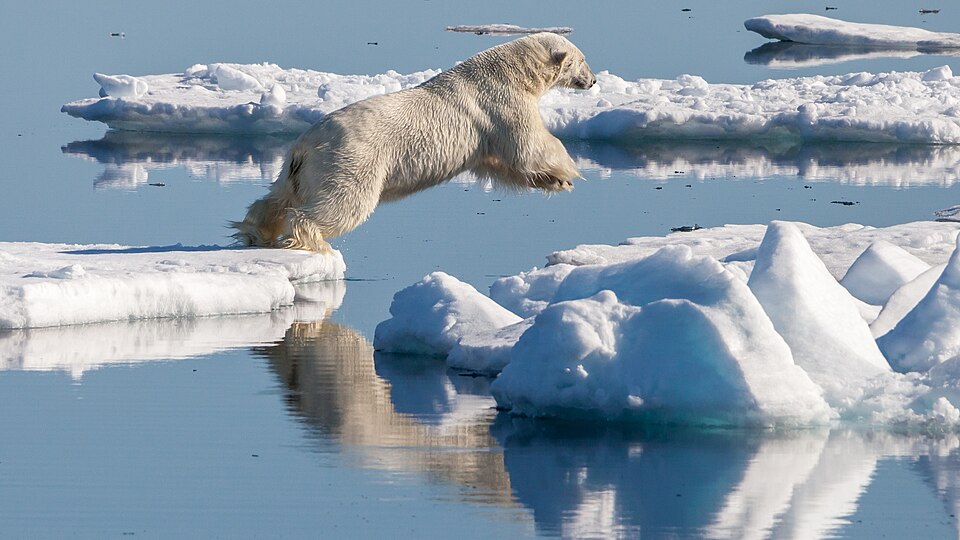
However, Vorkamp explains that climate change is making the picture increasingly complex. In East Greenland, changing sea ice conditions have altered polar bear diets, with hooded seals becoming more important prey than ringed seals. Because hooded seals contain higher concentrations of several pollutants, this dietary shift helps explain why some contaminant levels in polar bears are no longer declining as expected.
Climate change can also remobilise pollutants that have already been deposited in oceans, snow and ice. As sea ice retreats and temperatures rise, chemicals stored in the marine environment may be released back into the atmosphere, complicating efforts to evaluate whether international regulations are reducing environmental contamination.
Another challenge is the rapidly growing number of chemicals entering global markets. Rather than analysing only known contaminants, ArcSolution researchers increasingly use non-target screening techniques to identify previously unknown compounds in Arctic samples. Vorkamp also highlights the growing importance of plastic pollution, both as a contaminant itself and as a carrier of chemical additives throughout Arctic ecosystems.
Key takeaways from Segment 1
- Many Arctic pollutants originate far outside the region through long-range transport.
- Climate change is changing how pollutants move, accumulate and are redistributed.
- Changes in Arctic food webs can alter contaminant exposure even when emissions decline.
- New analytical methods are helping identify previously unknown contaminants.
- Plastic pollution is becoming an increasingly important part of Arctic pollution research.
Segment 2
Local emission sources of problematic chemicals
While long-range transport remains a defining feature of Arctic pollution, Roland Kallenborn explains that local emission sources are becoming increasingly important as human activity expands across the region.
Many Arctic communities are small, but mining, energy production, tourism, shipping, airports and wastewater systems can all contribute to local contamination. Historical industrial activities also leave lasting legacies, while new infrastructure introduces additional sources of pollutants.
Climate change further amplifies these challenges. Thawing permafrost, coastal erosion and the loss of sea ice can remobilise contaminants stored in soils and infrastructure, while also threatening settlements and increasing the need for adaptation.
Kallenborn also points to practical challenges in many remote Arctic communities. Wastewater treatment and drinking water systems often rely on simple infrastructure that cannot support advanced technical solutions. Developing locally adapted, robust and affordable systems therefore becomes essential for reducing environmental contamination while supporting healthy communities.
For ArcSolution, this means combining scientific knowledge with practical solutions that communities themselves can maintain. The project explores approaches based on locally available resources, including circular solutions for wastewater treatment and resource recovery that can function under Arctic conditions.
Key takeaways from Segment 2
- Local pollution sources are becoming increasingly significant across the Arctic.
- Climate change can mobilise contaminants from existing infrastructure and contaminated sites.
- Small Arctic communities require solutions adapted to local conditions and available resources.
- Sustainable wastewater and drinking water management are central parts of ArcSolution’s work.
- Long-term solutions depend on combining research with community-based implementation.
To sum it all up
Webinar #3 demonstrates that Arctic pollution can no longer be understood solely through long-range transport. Climate change is reshaping how contaminants move through the environment, while increasing human activity is creating new local sources of pollution across the region.
Together, the presentations by Katrin Vorkamp and Roland Kallenborn show why addressing these challenges requires both continued international cooperation and practical, locally adapted solutions. Understanding the interactions between climate, pollution and Arctic communities remains a central part of ArcSolution’s work.